
Knee pain is a common reason people seek treatment, particularly as they get older. One of the most common causes of persistent knee pain is knee osteoarthritis (OA).
If you have been diagnosed with knee osteoarthritis, you may be wondering:
Can chiropractic help?
The answer is that chiropractic care may help some people manage pain, stiffness and movement, particularly when hands-on treatment is combined with exercise and other appropriate therapies.
However, chiropractic treatment does not cure osteoarthritis or restore damaged cartilage. The goal is to help you manage your symptoms and maintain your ability to move and stay active.
What is knee osteoarthritis?
Knee osteoarthritis is a condition involving changes to the structures within the knee joint. It can cause:
- Knee pain, particularly when walking, climbing stairs or squatting
- Stiffness after prolonged sitting or inactivity
- Reduced knee movement
- Difficulty with daily activities
- Swelling or tenderness around the knee
- Reduced confidence with walking or exercise
Osteoarthritis does not affect everyone in the same way. Two people may have similar changes on an X-ray but experience very different levels of pain and functional limitations.
This is why a proper assessment is important.
Can chiropractic help knee osteoarthritis? It may help some people manage their symptoms and improve function.
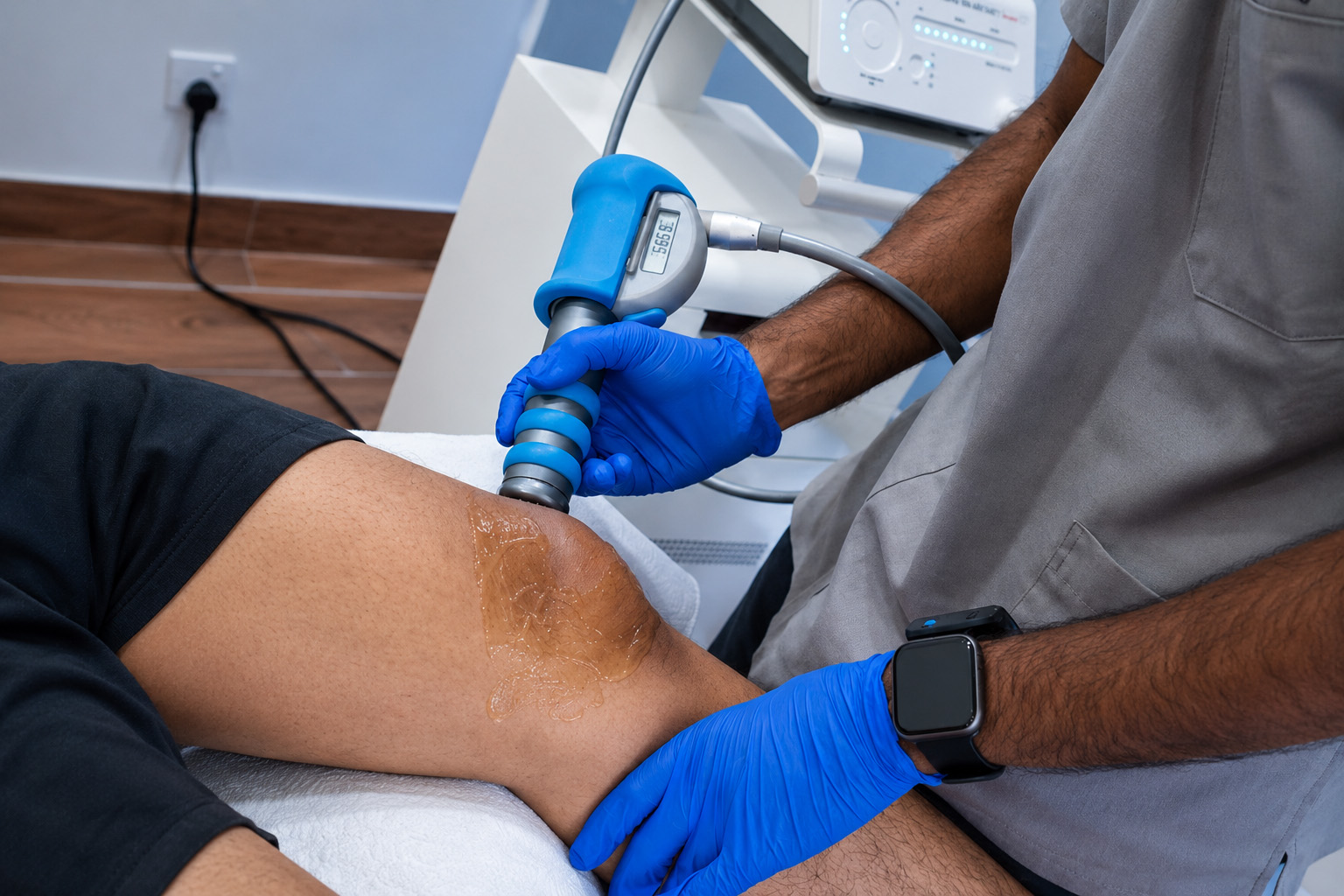
Chiropractic care for someone with knee osteoarthritis may include a combination of manual therapy, exercise, electrotherapy and, where appropriate, shockwave therapy.
The exact treatment should depend on the individual’s symptoms, examination findings, activity level and overall health.
Importantly, treatment should not simply focus on the knee joint. Your chiropractor should assess how you move, your strength, mobility and other factors that may be contributing to your symptoms.
What treatments may be used?
1. Manual therapy
Manual therapy may include joint mobilisation and other appropriate hands-on techniques to help improve joint movement and reduce symptoms.
For knee osteoarthritis, manual therapy is generally best considered alongside an exercise programme rather than as a standalone treatment.
2. Exercise therapy
Exercise is an important part of managing knee osteoarthritis.
Depending on your condition, exercises may focus on:
- Quadriceps and lower-limb strengthening
- Hip and knee control
- Flexibility and mobility
- Balance
- General aerobic fitness
- Gradual return to activities that you enjoy
The exercises should be selected according to your individual ability rather than simply following a generic exercise programme.
3. Electrotherapy
Electrotherapy may be used as an adjunctive treatment for some patients with knee pain.
Depending on the type of electrotherapy used, it may help with pain management or provide short-term symptom relief, allowing the patient to participate more comfortably in exercise and rehabilitation.
It should not be viewed as a treatment that reverses osteoarthritis or repairs damaged cartilage.
Your chiropractor should determine whether electrotherapy is appropriate for you based on your symptoms and medical history.
4. Shockwave therapy
Shockwave therapy may also be considered for selected patients with knee-related musculoskeletal pain.
It uses acoustic pressure waves delivered to specific tissues and is different from a chiropractic adjustment.
Shockwave therapy may be useful in certain conditions involving the soft tissues around the knee, depending on the diagnosis.
However, shockwave therapy is not a cure for knee osteoarthritis and should not be presented as a way to regenerate worn-out cartilage.
The decision to use shockwave therapy should be based on the actual source of the patient’s pain rather than simply because they have been diagnosed with knee OA.
5. Activity and lifestyle advice
Managing knee osteoarthritis is not only about what happens inside the clinic.
Your chiropractor may also discuss:
- Appropriate physical activity
- Weight management where relevant
- Activity modification
- Pacing strategies
- Ways to gradually return to exercise
The objective is to help you remain as active and independent as possible.
Choosing a chiropractor for knee pain in Kuala Lumpur
If you are considering chiropractic care for knee osteoarthritis, don’t choose a practitioner simply because they advertise a particular treatment or promise to “fix” your arthritis.
Look for a chiropractor who:
- Takes a proper medical and symptom history
Performs an appropriate physical assessment
Explains the likely causes of your symptoms
Discusses different treatment options
Uses exercise and active rehabilitation where appropriate
Explains the benefits and limitations of treatment
Recognises when referral or further investigation is required
Is properly registered to practise - A good consultation should not begin with treatment before understanding the patient.
Can chiropractic help your knee osteoarthritis?
If you are living in Kuala Lumpur and experiencing knee osteoarthritis, chiropractic care may be one component of a broader management plan.
Depending on your individual condition, treatment may include manual therapy, exercise, electrotherapy and shockwave therapy, together with advice on activity and lifestyle.
The aim is not simply to “adjust the knee.”
The aim is to understand your condition, manage your symptoms, improve your movement and help you remain active.
Can chiropractic help knee osteoarthritis?
For some people, it can be part of a management plan to help with pain, mobility and function.
But there is no single treatment that works for everyone, and chiropractic care should not be promoted as a cure for osteoarthritis.
The most important thing is to receive an appropriate assessment and have a treatment plan that is based on your symptoms, your goals and your individual condition.
Your knee may have osteoarthritis. But your treatment should be about more than just the X-ray.
Sometimes—yes. Mild inflammation may improve within a few weeks.
However, pain that persists or returns is often due to misalignment, which typically requires professional correction.